The Slant on Spin Doctors

Other people’s thoughts, they ain’t your hand-me-downs.

— Spin Doctors (Little Miss Can’t Be Wrong).

Spin doctors. No, I am not talking about the 90’s band that encouraged you to just buy them the flowers if you wanted. A spin doctor in the realm of Public Relations are defined as a someone who is “responsible for ensuring that others interpret an event from a particular point of view” (https://www.merriam-webster.com/dictionary/spin%20doctor).

While The Practice of Public Relations (2020) states that the term spin originated during the Clinton administration, a New York Times article by William Safire (1986) shares the phrase was first found in an 1984 editorial about the Reagen-Mondale televised debates. The Washington Post picked the term up and defined spin doctors as ‘the advisers who talk to reporters and try to put their own spin, or analysis, on the story.’ This expression stuck and came to be used to describe intentionally skewing a message with slants and half-truths to sway the audience a certain direction.

Most commonly, and as in the case of its origination, we see spinning used in politics. This is often done to hide the truth, to make the truth not seem as bad, or to exaggerate positive claims. However, this method is no longer reserved for only politics. Often we see celebrities, athletes, and even businesses leaning on deception as a way to protect or repair an image.

Even Edward Bernays, regarded as the Father of Public Relations, has been referred to as the Father of Spin – particularly because he helped alcohol and tobacco companies market their products as socially acceptable (Valentini, 2016).

What separates the spin doctor from the public relations professional? While there are undoubtedly many similarities between the two professionals, public relations is founded in truth and honesty. In fact, the entirety of a person’s reputation and influence in the world of PR depends on their transparency and straightforwardness.

Chiara Valentini (2016), Associate Professor of Public Relations and Corporate Communication at Aarhus University in Denmark, points out three specific differences: goals, approaches to ethics, and the use of media channels. The goal of public relations is a mutual relationship and interest between two parties. On the other hand, the goal of spin doctoring is to tell one side of a story to improve the image or appeal of that party – even at the expense of ethics or honesty.

Learning to recognize the difference between the two, especially as someone on the receiving end, is not always an easy task. Knowing what spin doctoring is can be a helpful first step. Is the language being using confusing or misleading? Is it very emotional or critical (think of tweets we often see from the POTUS)? Is the information referenced or are you able to find conflicting data from trusted sources?

Ultimately the lines between public relations and spin doctoring will always be gray. Edward Bernays himself said “If I tell you to pick out a certain tie and you think that’s bad advice, you’ll call it manipulation. But if I use reason, persuasion, authority and tradition to show you why it’s a good idea to wear that tie, you’ll thank me for showing you facts you weren’t aware of. And you might just put on that tie.”

References

Farhi, P. (1991, November 23). The Original Spin Doctor. Retrieved from The Washington Post: https://www.washingtonpost.com/archive/lifestyle/1991/11/23/the-original-spin-doctor/109f782a-5964-4d99-94f7-b4b666bc1f74/?noredirect=on

Safire, W. (1986, August 31). On Language; Calling Dr. Spin. Retrieved from The New York Times Magazine: https://www.nytimes.com/1986/08/31/magazine/on-language-calling-dr-spin.html?Src=longreads

Seitel, F. (2020). The Practice of Public Relations. Boston: Pearson.

Valentini, C. (2016). Spin Doctoring. The International Encyclopedia of Political Communication. Retrieved from https://www.researchgate.net/publication/312540156_Spin_Doctoring

Thoughts on the PR Profession

I have enjoyed the last 8 weeks learning about what Public Relations (PR) truly entails, the differences between PR and other types of organizational outreach such as marketing and advertising, as well as some of the issues that PR is designed to handle.

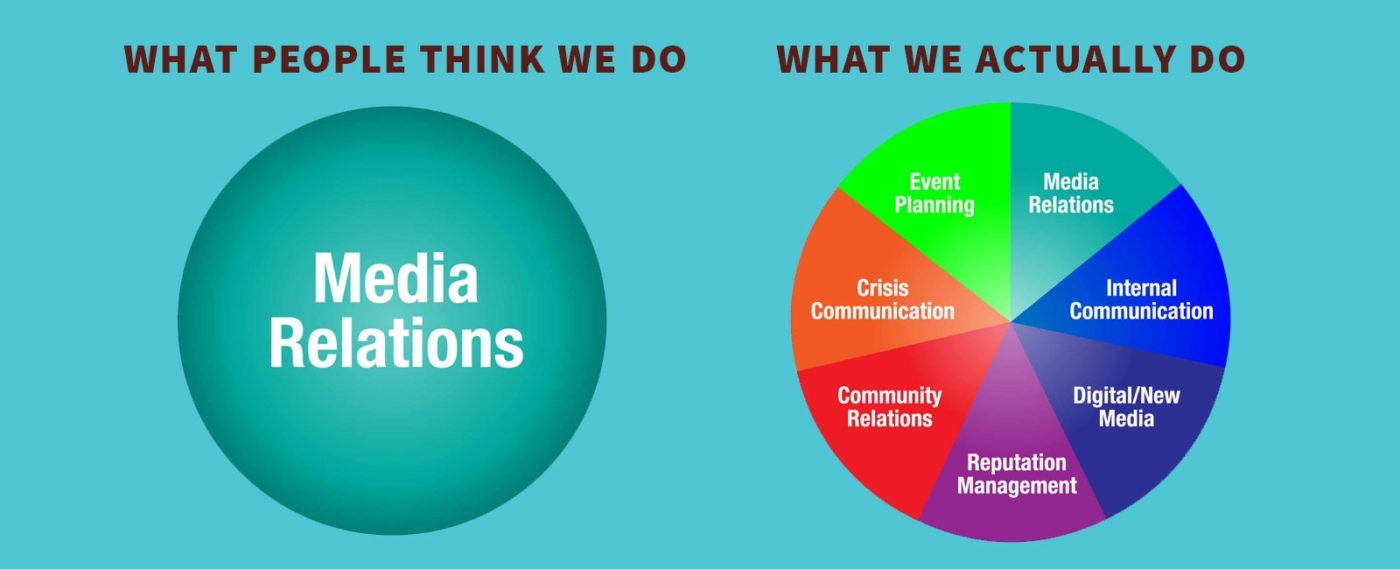
A PR professional has a lot of responsibility within an organization.  They must be ready to respond to a crisis at any given moment, as well as be proactive with a strategy should an issue occur.  Not only are they responsible for responding to emergency situations, a PR professional must also think about an organization’s overall message with employees, consumers, and even communities.  The PR professional must also be very close with administrators including the CEO to manage what is being shared with the media.  PR is a very big job!

The least interesting areas to me were ones that deal with government relations – lobbying, cleaning up the messes that politicians have made, or even being a press secretary would be a very high stress job where one must be constantly on and ready.

While I believe that PR is a very necessary role in any organization and can be very fun and exciting, it is not an area I would like to pursue exclusively.  Areas in PR that I am interested in include diversity, which is a very important field especially as more companies begin to pay attention to it.  I also find employee relations interesting, perhaps because employee relations is a big part of my administrative role.

PR is a field that will continue to grow, especially as social media and the internet become more and more instantaneous with news stories, reviews, and continuous feedback.  Have a communications strategy is more important than ever to an organization.  I look forward to applying all I have learned in this class to continue developing my personal brand, as well as helping organizations I am part of explore ways to improve their own PR practices!

Diversity – What Does That Mean?

Diversity is a very important topic in many organizations today.  So what exactly does it mean?  Diversity is a very broad description, and encompasses the differences among us as people.  These differences can include race, gender, religion, ethnicity, sexual orientation, ability/disability, and age just to name a few.

Organizations strive to have diversity for many reasons.  One of the most valuable reasons to have a diverse workforce is to bring a wider range of different ideas, skill sets, and culture to the business.  When an organization cares about the diversity of its employees and values those differences, it is likely to also be more open to innovation and new ideas.  It also gives you a broader representation of your client base, which can help you to better connect with and appeal to them. (https://www.forbes.com/sites/rsmdiscovery/2018/08/22/why-workplace-diversity-is-so-important-and-why-its-so-hard-to-achieve/#319945593096).

Diversity is also important to the local economy.  According to an article in the Houston Chronicle (https://smallbusiness.chron.com/diversity-workplace-important-employees-10812.html), when marginalized workers are unable to find gainful employment, they are unable to support themselves and their families.  In turn, the entire community suffers.  Providing opportunities to everyone is not only the right (and legal) thing to do, it is critical for the economy of the place where the organization has and/or does business.

Since it is the job of a PR professional to manage a company’s image and reputation, promoting diversity is important.  Diversity is good for a company’s image.  It shows customers that the business is open-minded, inclusive, and values differences.  I believe a company that cares about and sees the value of hiring individuals of all types also values its customers.  It gives the organization a boost in ethics and fairness, which is an essential quality that many consumers looks for.

Diversity is not always an easy task to tackle.  Finding a right fit for a position is still a critical component for any hiring team and you do not want to be guilty of hiring someone just for diversity’s stake.  Yet a company cannot get stuck in this as an excuse.  An article on Forbes titled How to Alter Your Hiring Practices to Increase Diversity makes a really great suggestion.  Inclusion and diversity should be a part of the culture.  Instead of hiring based on fit (people like us), hire based on who can expand who we are (https://www.forbes.com/sites/maynardwebb/2017/10/29/how-to-alter-your-hiring-practices-to-increase-diversity/#75c127562029).  This same article shares that in 2022 – which is only three years away – the workforce is expected to be comprised of 47% women and 40% minorities.  Diversity will soon no longer be an option but an expectation of companies.

Breaking (Fake) News!

Fake news.  Even the fact that Trump claimed to have invented the term in an October 2017 interview is fake news (https://www.americanbar.org/groups/crsj/publications/human_rights_magazine_home/the-ongoing-challenge-to-define-free-speech/getting-to-the-truth/?q=&wt=json&start=0).  In fact, this article by the American Bar Association (ABA) states that the Nazis had used a similar term during the 1930’s: Lügenpresse, which means lying press.  The Center for Democracy & Technology have been using the slogan “Stop Fake News” since 1993.  So what Trump calls one of the greatest terms he’s ever come up with is, in fact, not his term at all.  He did, however, make it a common term in language regarding media today.

Trump is not the only one who believes the media is untruthful.  The ABA also states that three out of four Americans believe that fake news is regularly reported by the media. In fact, the Pew Research Center’s data shows that Americans believe that made-up news is a bigger issue than climate change, racism, and even terrorism ( https://www.journalism.org/2019/06/05/many-americans-say-made-up-news-is-a-critical-problem-that-needs-to-be-fixed/). Interestingly, those polled believe that the fault falls more to political leaders than the journalists themselves. However, they believe journalists are responsible for fixing the issue.

For a Public Relations professional representing one of the media companies labeled as reporting fake news, it can be a nightmare to undo the damage done to the company’s reputation.  As we know, honesty and transparency are the most important principles in PR.  Once the public has lost their trust in a media source, it can be very difficult to gain it back.

In order to begin repairing the trust lost with the public, it is critical that the organization admit to their mistake immediately and apologetically.  Accepting responsibility for lying, rather than dismissing it or attempting to cover it up, can go a long ways towards rebuilding trust.  The PR professional should also ensure that this does not occur again.  If it does, apologizing will be unlikely to work a second time.

Forbes (https://www.forbes.com/sites/forbescommunicationscouncil/2018/12/18/11-pr-strategies-for-putting-out-a-fake-news-fire/#358e9b243436) has shared several tips on putting out a “Fake News Fire”.  Below are a few of my favorites:

Ideally, the PR professional will have prevented fake news from happening before it has ever even occurred. If not however, these tips will help get the organization back on track.

Ethics – I swear to tell the truth, the whole truth…

Ethics can look different depending on the type of industry being discussed.  For example, ethics in government has a very public eye.  Citizens expect that politicians will behave ethically, and they also feel like politicians have an obligation to them to not only behave ethically but answer for it when they do not.  With the media’s close watch on politics, much of their actions are in the public eye and are gleefully reported by news stations who want to increase their viewership.  Not behaving ethically can cause a politician to not be reelected, be impeached, or even potentially face criminal charges.

In journalism, they have their own code of ethics that they honor.  As an example, they should not invade anyone’s right to privacy, report unofficial charges without giving the accused an opportunity to respond, or simply report on morbid things for publicity.  According to The Practice of Public Relations, they should “show respect for the dignity, privacy, rights, and well-being” in the course of researching and reporting the news.  Similar to politics, however, journalists do not always honor this code.  Unfortunately many times they will exaggerate the truth, leak private information, or even participate in such ethical issues as sexual harassment.  Consumers of media also expect a level of trust from journalists, although that trust has waned over the years.

Public relations professionals are the key to ensuring ethical behavior by an organization, regardless of what that code of ethics is.  They set the standard for the organization and should work to promote it with others.

The Public Relations Society of America (PRSA) has their own set of guidelines (https://www.prsa.org/about/ethics/prsa-code-of-ethics)

 A member shall:

It is critical for public relations professionals to maintain their respect in order to maintain their credibility.  It will be very difficult to persuade others to maintain the same standards if the keepers of ethics themselves do not.

The Public Relations Plan – Why You Need It

Why might an organization consider creating a Public Relations plan? PR News ( https://www.prnewsonline.com/comprehensive-pr-plan) identifies two reasons: 1.) to increase awareness of a company/organization attempting to enter new markets, or 2.) to increase awareness of a company/organization currently experiencing a slow-down in market segments or wanting to increase awareness of a new product or division.

One could argue that for Public Relations to be successful, having a plan is a critical piece of the puzzle. Martha Whiteley shares on the PRSA blog PRSay that launching a PR campaign without a plan is like going on a trip without a map (https://prsay.prsa.org/2013/08/27/strategic-public-relations-planning-positioning-for-success/).  How do you know what your destination is, and stops you should make along the way?  Why are you going to begin with?  The Public Relations plan helps you map this out and you get there.

The Practice of Public Relations shares four areas that a Public Relations plan should include: objectives and strategies, planning and budgets, as well as research and evaluation.  Let’s break that down a little further:

Defining the Problem or Opportunity

To know how you are going to get there (the plan), intentionally deciding where you are going is the first step.  At this stage, the purpose is to establish some communication objectives.  Whiteley advises on her blog post not to confuse objectives and goals.  Goals convey the organization’s mission or vision.  Objectives are clear, measurable statements based on those goals.

Programming

This is the official planning stage, and should include researching what needs to be accomplished.  This is also the time to identify strategies and tactics – what needs to happen to meet the objectives identified in the first step?

Action

Time to implement!  Once the first two steps are completed, the timeline is ready to be launched.

Evaluation

Once the action phase has concluded, and very important step that should not be left out is the wrap-up.  What worked?  What did not work?  What is left to accomplish?

The effectiveness of the plan is dependent upon the pre-work completed in the first two steps.  If the objectives clearly align with the purpose of the organization and what the team wants to accomplish through creating a public relations plan, then the implementation should follow effortlessly.  The outcomes that can be expected should be established in the Programming stage, when the plan is being created.

The Business of Persuasion

There is a fine line between persuasion and propaganda, one that the average consumer of public relations may not pick up on – after all, those proffering propaganda don’t want you to see a difference!  According to SAGE Publications, Inc., propaganda is a form of communication that aims to further the ambitions of the propagandist.  Persuasion, on the other hand, is a two-way street and should be beneficial for both the persuader and the one being persuaded.

Public relations often gets a bad rap because of the misunderstanding between these two methods.  The Practice of Public Relations says that good public relations is about ethics, truth, and credibility.  If the objective of the propagandist is to promote their agenda, can it be considered any of those?   In our blog post a few weeks ago, we looked at one technique that gives a negative stereotype to public relations – spinning.  Using this method, a spin doctor tells a tale so that listeners interpret it with a particular mindset.

Other commonly used propaganda techniques are bandwagon.  Have you watched a political campaign ad recently?  They are often filled with bandwagon propaganda, often referring to what ‘most Americans’ believe.  This is a favorite method among politicians and is where the name got its origins.  The book Techniques of Propaganda & Persuasion describes how in the 19th century, politicians would tag along with traveling circuses or live orchestras – known as a bandwagon – where they would draw crowds with their speeches.  Other politicians would try to jump on board the popular bandwagons even if they didn’t necessarily agree with the message and thus the term was coined.

Another popular technique referred to in Techniques of Propaganda & Persuasion is card stacking, which is similar to spinning.  This is also a favorite among politicians and campaign ads when information is shared that while might be ‘truthful’ is taken out of context or obscured so much that the propagandist is given an unfair advantage.  I recently watched a campaign ad from the 2012 election in which the candidate shared just a snippet from a speech his opponent had given.  He built his entire ad around this out-of-context information, which can be confirmed by viewing the original speech.  If you would like to take a look at this campaign ad, you can find it here: https://www.youtube.com/watch?v=C2YvKdMchp0

Public relations professionals can help themselves avoid the negative connotations of propaganda by following the golden rule of PR: never tell a lie.  Persuasion can be accomplished while remaining ethical.  When you are truthful, even when it is difficult, it is easier to gain and keep the trust and respect of your audience.  We are more likely to forgive a person or an organization that admits to a mistake and attempts to fix it while communicating along the way then we are when the tracks have been covered and the hope is that customers or constituents never find out.  Just like when Ivy Lee, the father of public relations, persuaded Rockefeller to listen to workers grievances’ and saw success, so should modern public relations professionals advocate on behalf of those they represent to treat others with respect.  Only then can it become a two-way street.

Oh Snap! Marketing to Young Adults on Social Media

If you are unfamiliar with Snapchat, it is an app that is used on a cell phone to take photos and videos that you can either send directly to friends or share on your story, which means viewable to anyone you are friends with.  The ones to friends disappear immediately, and on your story they can be viewed for 24 hours – unless someone takes a screenshot, which you are alerted to.  Snapchat might be most known for its array of changing filters that allow you to view yourself with animal ears, big lips, or even a beautifying blurring filter.

According to Statista (Clement, 2019), Snapchat had 203 million daily active users worldwide.  Statista also reported that in a study from spring of this year, U.S. teenagers shared Snapchat is the most important social network of their generation.  In fact, 78% of 18 to 24 year olds in the U.S. use Snapchat.

What could utilizing this platform mean for companies exploring new marketing options for young adults?  Potentially throwing open doors to prospects and receiving higher engagement.  Entrepreneur states that Snapchat gets almost 4 times higher engagement rate than similar platforms such as Instagram (Siu, 2017).  Entrepreneur also shares some ways that marketing can be effective through Snapchat: Offer promo codes, launching new products, and leveraging influencer marketing.

I believe the latter is one of the best ways to successfully utilize social media, but especially with Snapchat because it allows you to share not only with all of your followers but those of the influencer as well.  It can also be a relatively inexpensive way to market compared to purchasing ad space on other platforms.

On the flip side of appealing to young adults, Snapchat is certainly not a way to market to older generations.  Depending on the product and target audience you are hoping to reach, another method might be more effective.  The Snapchat usage rate for those 50 and above is only 7% (Influencer Marketing Hub, 2019).  However, it can certainly play an important role in your overall marketing strategy!

References

Clement, J. (2019, August 14). Daily active users of Snapchat 2014-2019. Retrieved from Statista: https://www.statista.com/statistics/545967/snapchat-app-dau/

Influencer Marketing Hub. (2019, April 30). Snapchat Statistics, Revenue, and More. Retrieved from Influencer Marketing Hub: https://influencermarketinghub.com/snapchat-statistics-revenue/

Siu, E. (2017, February 21). 3 Ways to Use Snapchat for Marketing. Retrieved from Entrepreneur: https://www.entrepreneur.com/article/289286